Study Proposal
Berghuis, Mark Allard (6-4-2010 ) (Delft) DUT Faculty of Architecture
CONTENTS
Hieronder is te zien hoe mijn Study Proposal is met behulp van het programma Future Impact.
1 OBJECT OF STUDY AND ITS CONTEXT
<give headings like this an automatically numbered heading 1 profile in Word and remove the superfluous second number>
1.1 OBJECT OF MY STUDY
<give headings like this an automatically numbered heading 2 profile in Word and remove the superfluous second number>
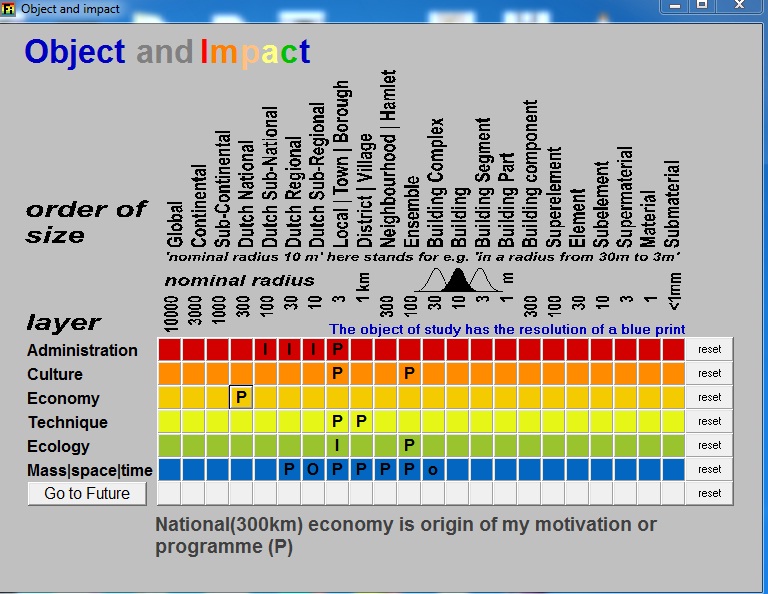
The object of study has the resolution of a blue print for 2030 on Subregional(10km) scale with smallest details on Buildingcomplex(30m) level.
1.2 PROBABLE FUTURE CONTEXT: FIELD OF PROBLEMS
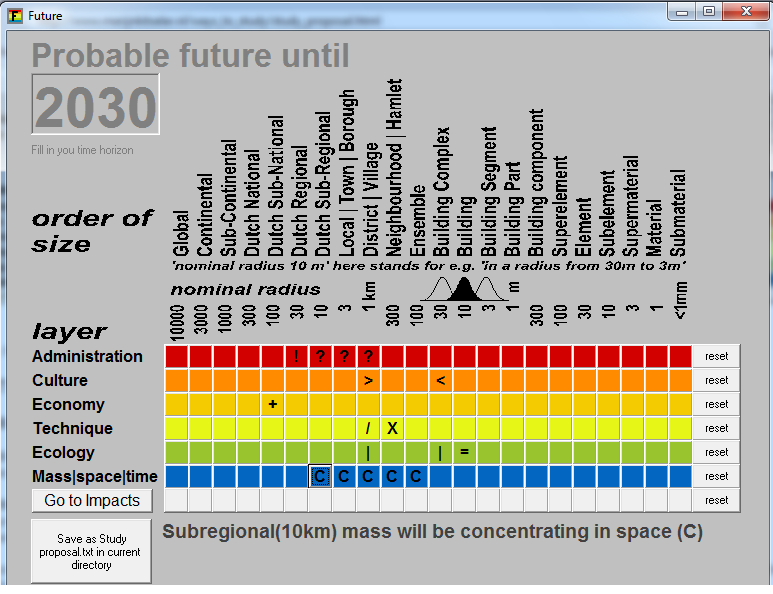
My assumptions about the probable future context of the object of study until 2030 are:
<start selecting text on the beginning of next line choosing <table, convert text into table>>
Future 2030 Global(10000km) Continental(3000km) Subcontinental(1000km) National(300km) Subnational(100km) Regional(30km) Subregional(10km) Town(3km) District(1km) Neighbourhood(300m) Ensemble(100m) Buildingcomplex(30m) Building(10m) Buildingsegment(3m) Buildingpart(1m) Buildingcomponent(300mm) Superelement(100mm) Element(30mm) Subelement(10mm) Supermaterial(3mm) Material(1mm) Submaterial(<1mm)
management ! ? ? ?
culture > <
economy +
technique / x
ecology | | =
mass C C C C C
<stop selecting text on the end of previous line choosing <table, convert text into table>>
<put the letters of the first row upright and stretch the height of the row to fit on page>
<if the table is still too wide, decrease the margins per cell in table properties>
Legend:
management is initiating (!) or executing or controlling initiatives (?)
culture is innovative (>) or traditional (<)
economy is growing (+) or declining (-)
technique is internally specializing subfunctions (/) or internally combining subfunctions (X)
ecology is internally differentiating into heterogeneity (|) or internally egalizing into homogeneity (=)
mass is concentrating in space (C) or dispersing in space (D)
As far as this future is not desirable it will generate a field of problems (Jong and Priemus(2002)).
As relevant probable but undesired developments (emerging problems) I consider: ....
<explain here how the expected future could give problems partly to be solved by your study>
1.3 DESIRED IMPACTS OF MY STUDY: FIELD OF AIMS
My study derives its motivation, intention, aims or even programme of requirements from fields indicated by a P in the next table:
<start selecting text on the beginning of next line choosing <table, convert text into table>>
Impacts 2030 Global(10000km) Continental(3000km) Subcontinental(1000km) National(300km) Subnational(100km) Regional(30km) Subregional(10km) Town(3km) District(1km) Neighbourhood(300m) Ensemble(100m) Buildingcomplex(30m) Building(10m) Buildingsegment(3m) Buildingpart(1m) Buildingcomponent(300mm) Superelement(100mm) Element(30mm) Subelement(10mm) Supermaterial(3mm) Material(1mm) Submaterial(<1mm)
management I I I P
culture P P
economy P
technique P P
ecology I P
mass P O P P P P o
<stop selecting text on the end of previous line choosing <table, convert text into table>>
<put the letters of the first row upright and stretch the height of the row to fit on page>
Legend:
largest drawn frame of study (O) and smallest characteristic detail of study (o)
affected without intention (I) or origin of my motivation or programme (P)
They also indicate which actors (problem owners) will be primarily favoured by realising the results of my study:
<for every field, indicated by a P, try to write down here which actors will be favoured by your study, change next lines as reminders into your own words>
Actors in management on the level of
executing or controlling initiatives (?) Town(3km) like ...
Actors in culture on the level of
innovative (>) Town(3km) like ...
traditional (<) Ensemble(100m) like ...
Actors in economy on the level of
growing (+) National(300km) like ...
Actors in technique on the level of
internally specializing subfunctions (/) Town(3km) like ...
internally combining subfunctions (X) District(1km) like ...
Actors in ecology on the level of
internally differentiating into heterogeneity (|) Ensemble(100m) like ...
Actors in mass on the level of
concentrating in space (C) Regional(30km) like ...
concentrating in space (C) Town(3km) like ...
concentrating in space (C) District(1km) like ...
concentrating in space (C) Neighbourhood(300m) like ...
Ensemble(100m) like ...
They possibly will support an assignment and programme of requirements to change undesired developments.
Unintended impacts in the fields indicated by an I in the table above could put other actors at a disadvantage like:
<for every field, indicated by an I, try to write down here which actors will be put at a disadvantage by your study, change next lines as reminders into your own words>
Actors in management on the level of
initiating (!) Subnational(100km) like ...
executing or controlling initiatives (?) Regional(30km) like ...
executing or controlling initiatives (?) Subregional(10km) like ...
Actors in ecology on the level of
internally differentiating into heterogeneity (|) Town(3km) like ...
1.4 MY DESIGNERLY REFERENCES: FIELD OF MEANS
Previous public examples with similar context below fascinate me professionally.
<give here at least two images of design, their source, keywords describing what is readable from the images, relevant for your study>
<put the images in a Word table to avoid 'swimming' in your Word document>
A programme of requirements resulting in designs like this would contain next elements:
<write a programme of requirements that could have been the basis of these designs>
From these images I derive next types of composition, components and details, relevant in my study.
<search for relevant key words in T. M. d. Jong and D. J. H. v. d. Voordt Ways to research and study urban, architectural and technical design (Delft) Delft University Press, refer properly to chapters and draw relevant types>
<make a typological inquiry into the images with sketches and explanations>
From these images I derive next possible generating conceptions directing my study.
<read Leupen (2002), search for relevant key words in T. M. d. Jong and D. J. H. v. d. Voordt Ways to research and study urban, architectural and technical design (Delft) Delft University Press, refer properly to chapters>
<write and draw possible conceptions that can give your study direction in all its phases>
To elaborate and evaluate such types and conceptions for my study next kinds of models could be used:
<search for relevant key words in T. M. d. Jong and D. J. H. v. d. Voordt Ways to research and study urban, architectural and technical design (Delft) Delft University Press, refer properly to chapters>
<read Klaasen (2002); describe verbal, mathematical, spatial, mechanical or other models useful for your study>
To use such models I will need data and assumptions. Sources where I can find data are:
<name sources where you can find data for your study within the available time>
For data I cannot find within the available time, I will make assumptions like:
<name assumptions you are not going to research in further detail>
They are supposed to be elaborated in other studies.
key words: <describe possibly useful methods for your study; change next lines as reminders into your own words>
<search for relevant key words in T. M. d. Jong and D. J. H. v. d. Voordt Ways to research and study urban, architectural and technical design (Delft) Delft University Press, refer properly to chapters; change next lines as reminders into your own words>
Useful methods of naming and describing are: …
Useful methods of design research and typology are: …
Useful methods of evaluating are: …
Useful methods of modelling are: …
Useful methods of programming and optimising are: …
Useful methods of technical study are: …
Useful methods of design study are: …
Useful methods of study by design are: …
1.5 MY PORTFOLIO AND PERSPECTIVE: FIELD OF ABILITIES
From my previous work next elements are useful for this project.
<give relevant examples and at least two images of your previous work, the ways you studied best (organogram) and the progress you want to make in this project>
In this project also new elements will be developed.
<make a critical analysis of your previous work, describe how to improve existing abilities or develop new ones>
2 MY STUDY PROPOSAL
2.1 LOCATION AND OTHER FUTURE CONTEXT FACTORS
The object of study has the resolution of a blue print for 2030 on Subregional(10km) scale with smallest details on Buildingcomplex(30m) level. The actual object will be located in ....
<if you already have chosen a location, give a map and other images of the location here; if not, describe criteria for a location relevant to your study>
If the context will change like I assumed in 1.2 it wil influence the location as follows.
<for every field, write down how it will influence your location. Change next lines as reminders into your own words>
If management will be initiating (!) on Subnational(100km) not on Regional(30km) not on Subregional(10km) not on Town(3km) level, it will influence the location by ....
If culture will be innovative (>) on Town(3km) not on Ensemble(100m) level, it will influence the location by ....
If economy will be growing (+) on National(300km) level, it will influence the location by ....
If technique will be internally specializing subfunctions (/) on Town(3km) not on District(1km) level, it will influence the location by ....
If ecology will be internally differentiating into heterogeneity (|) on Town(3km), on Ensemble(100m), not on Buildingcomplex(30m) level, it will influence the location by ....
If mass will be concentrating in space (C) on Regional(30km), on Subregional(10km), on Town(3km), on District(1km), on Neighbourhood(300m) level, it will influence the location by ....
2.2 MOTIVATION OR PROGRAMME OF REQUIREMENTS
With regard to my assumptions about the future context (1.2) and referring to the intended impacts (1.3) as a result of this study:
<for every field, indicated as a P, try to write down how it motivates your study. If possible, elaborate that motivation into more precise intentions, aims or even programme points; change next lines as reminders into your own words>
Town(3km) management usually executing or controlling initiatives (?) should ...
Town(3km) culture usually innovative (>) should ...
Ensemble(100m) culture usually traditional (<) should ...
National(300km) economy usually growing (+) should ...
Town(3km) technique usually internally specializing subfunctions (/) should ...
District(1km) technique usually internally combining subfunctions (X) should ...
Ensemble(100m) ecology usually internally differentiating into heterogeneity (|) should ...
Regional(30km) mass usually concentrating in space (C) should ...
Town(3km) mass usually concentrating in space (C) should ...
District(1km) mass usually concentrating in space (C) should ...
Neighbourhood(300m) mass usually concentrating in space (C) should ...
Ensemble(100m) mass should ...
2.3 INTENDED RESULTS, CONTRIBUTIONS AND PLANNING
I expect next products of my study.
<write down which products this study will produce in a limited period, limiting its object to converge to that result>
It will give a contribution to the research of my studio ... by ...
<write down how your proposal will contribute to the research of the Faculty>
It has enough limitations to be realised in next time table
<add here a time table>
3 ACCOUNTS
3.1 MEETING CRITERIA FOR A STUDY PROPOSAL
According to Jong and Voordt eds. (2002), page 28 - 31 this study proposal demonstrates:
A Affinity with designing.
<write down how you have proven your affinity with designing in this study proposal>
B University latitude.
<write down how you have proven your University latitude in this study proposal>
C Concept formation and transferability.
<write down how developed concepts will become understandable and tranferable to others>
D Retrievability and Accumulating capacity.
<write down how this study will be published (website, reports, expositions) to be retrievable by others and how it contributes to science>
E Methodical accountability and depth.
<write down which scientific methods are proposed in this study proposal; are they primalily empirical, designerly or do they alternate?>
<Search for relevant key words in T. M. d. Jong and D. J. H. v. d. Voordt Ways to research and study urban, architectural and technical design (Delft) Delft University Press, refer properly to chapters and name relevant types>
F Ability to be criticised and to criticise.
<write down how this study will be open to criticism by others and will improve previous studies based on your own criticism (refer to them!)>
G Convergence and limitations.
<write down how this study proposal guarantees to converge to clear cut products without loosing University latitude>
3.2 REFERENCES
<Add and remove titles.>
Bergh, W. F. v. d. (2002) Contemplations for Copenhagen in: T. M. d. Jong and D. J. M. v. d. Voordt; Ways to study and research urban, architectural and technical design (Delft) Delft University Press Science; key words: <describe in key words why you choose this title>
Breen, J. L. H. (2002) Design driven research in: T. M. d. Jong and D. J. M. v. d. Voordt; Ways to study and research urban, architectural and technical design (Delft) Delft University Press Science; key words: <describe in key words why you choose this title>
Breen, J. L. H. (2002) Designerly Enquiry in: T. M. d. Jong and D. J. M. v. d. Voordt; Ways to study and research urban, architectural and technical design (Delft) Delft University Press Science; key words: <describe in key words why you choose this title>
Breen, J. L. H. (2002) Learning from The Bridge project in: T. M. d. Jong and D. J. M. v. d. Voordt; Ways to study and research urban, architectural and technical design (Delft) Delft University Press Science; key words: <describe in key words why you choose this title>
Brouwer, J., P. J. v. Eldijk, et al. (2002) Designing an office in: T. M. d. Jong and D. J. M. v. d. Voordt; Ways to study and research urban, architectural and technical design (Delft) Delft University Press Science; key words: <describe in key words why you choose this title>
Cuperus, Y. J. (2002) Classification and combination in: T. M. d. Jong and D. J. M. v. d. Voordt; Ways to study and research urban, architectural and technical design (Delft) Delft University Press Science; key words: <describe in key words why you choose this title>
Duijvestein, C. A. J. (2002) The environmental maximisation method in: T. M. d. Jong and D. J. M. v. d. Voordt; Ways to study and research urban, architectural and technical design (Delft) Delft University Press Science; key words: <describe in key words why you choose this title>
Eekhout, A. C. J. M. (2002) Methodology and component development in: T. M. d. Jong and D. J. M. v. d. Voordt; Ways to study and research urban, architectural and technical design (Delft) Delft University Press Science; key words: <describe in key words why you choose this title>
Eekhout, A. C. J. M. (2002) Programming Building Construction in: T. M. d. Jong and D. J. M. v. d. Voordt; Ways to study and research urban, architectural and technical design (Delft) Delft University Press Science; key words: <describe in key words why you choose this title>
Fokkema, J. T. (2002) Preface in: T. M. de and D. J. M. v. d. Voordt Jong Ways to study and research urban, architectural and technical design. (Delft) Delft University Press Science; key words: <describe in key words why you choose this title>
Frieling, D. H. (2002) Design in strategy in: T. M. d. Jong and D. J. M. v. d. Voordt; Ways to study urban, architectural and technical design (Delft) Delft University Press Science; key words: <describe in key words why you choose this title>
Geuze, A., P. J. v. Eldijk, et al. (2002) Experience intuition and conception in: T. M. d. Jong and D. J. M. v. d. Voordt; Ways to study and research urban, architectural and technical design (Delft) Delft University Press Science; key words: <describe in key words why you choose this title>
Guyt, P. and E. D. Hulsbergen (2002) Urban Programming Research in: T. M. d. Jong and D. J. M. v. d. Voordt; Ways to study and research urban, architectural and technical design (Delft) Delft University Press Science; key words: <describe in key words why you choose this title>
Heeling, J., P. J. v. Eldijk, et al. (2002) Designing a village in: T. M. d. Jong and D. J. M. v. d. Voordt; Ways to study and research urban, architectural and technical design (Delft) Delft University Press Science; key words: <describe in key words why you choose this title>
Hertzberger, H. (2002) Creating space of thought in: T. M. d. Jong and D. J. M. v. d. Voordt; Ways to research and study urban, architectural and technological design (Delft) Delft University Press Science; key words: <describe in key words why you choose this title>
Hertzberger, H. (2002) Perceiving and conceiving in: T. M. d. Jong and D. J. M. v. d. Voordt; Ways to study and research urban, architectural and technical design (Delft) Delft University Press Science; key words: <describe in key words why you choose this title>
Hobma, F. A. M. and E. T. Schutte-Postma (2002) Casuistry resulting in laws in: T. M. d. Jong and D. J. M. v. d. Voordt; Ways to study and research urban, architectural and technical design (Delft) Delft University Press Science; key words: <describe in key words why you choose this title>
Houben, P. P. J. A. M. (2002) Optimising performance requirements in: T. M. d. Jong and D. J. M. v. d. Voordt; Ways to study and research urban, architectural and technical design (Delft) Delft University Press Science; key words: <describe in key words why you choose this title>
Hulsbergen, E. D. and P. v. d. Schaaf (2002) Ex ante research in: T. M. d. Jong and D. J. M. v. d. Voordt; Ways to study and research urban, architectural and technical design (Delft) Delft University Press Science; key words: <describe in key words why you choose this title>
Jager, A. (2002) Industrial design methods in: T. M. d. Jong and D. J. M. v. d. Voordt; Ways to study and research urban, architectural and technical design (Delft) Delft University Press Science; key words: <describe in key words why you choose this title>
Jong, T. M. d. (2002) Comparing and evaluating drawings in: T. M. d. Jong and D. J. H. v. d. Voordt Ways to research and study urban, architectural and technical design (Delft) Delft University Press Science; key words: <describe in key words why you choose this title>
Jong, T. M. d. (2002) Designing in a determined context in: T. M. d. Jong and D. J. H. v. d. Voordt Ways to research and study urban, architectural and technical design (Delft) Delft University Press Science; key words: <describe in key words why you choose this title>
Jong, T. M. d. (2002) Verbal models in: T. M. d. Jong and D. J. H. v. d. Voordt Ways to research and study urban, architectural and technical design (Delft) Delft University Press Science; key words: <describe in key words why you choose this title>
Jong, T. M. d. and L. v. Duin (2002) Design research in: T. M. d. Jong and D. J. H. v. d. Voordt Ways to research and study urban, architectural and technical design (Delft) Delft University Press Science; key words: <describe in key words why you choose this title>
Jong, T. M. d. and H. Engel (2002) Typological research in: T. M. d. Jong and D. J. H. v. d. Voordt Ways to research and study urban, architectural and technical design (Delft) Delft University Press Science; key words: <describe in key words why you choose this title>
Jong, T. M. d. and R. P. d. Graaf (2002) Mathematical models in: T. M. d. Jong and D. J. H. v. d. Voordt Ways to study urban, architectural and technical design (Delft) Delft University Press Science; key words: <describe in key words why you choose this title>
Jong, T. M. d. and H. Priemus (2002) Forecasting and Problem Spotting in: T. M. d. Jong and D. J. H. v. d. Voordt Ways to research and study urban, architectural and technical design (Delft) Delft University Press Science; key words: <describe in key words why you choose this title>
Jong, T. M. d. and J. J. Rosemann (2002) Formation of the image in: T. M. d. Jong and D. J. H. v. d. Voordt Ways to research and study urban, architectural and technical design (Delft) Delft University Press Science; key words: <describe in key words why you choose this title>
Jong, T. M. d. and J. J. Rosemann (2002) Naming components and concepts in: T. M. d. Jong and D. J. H. v. d. Voordt Ways to research and study urban, architectural and technical design (Delft) Delft University Press Science; key words: <describe in key words why you choose this title>
Jong, T. M. d. and D. J. M. v. d. Voordt (2002) Criteria for scientific study and design in: T. M. d. Jong and D. J. M. v. d. Voordt; Ways to research and study urban, architectural and technical design (Delft) Delft University Press Science; key words: <describe in key words why you choose this title>
Jong, T. M. d. and D. J. M. v. d. Voordt (2002) Retrieval and Reference in: T. M. d. Jong and D. J. H. v. d. Voordt Ways to research and study urban, architectural and technical design (Delft) Delft University Press
Jong, T. M. d. and D. J. M. v. d. Voordt (2002) Ways to study A Naming and describing in: T. M. d. Jong and D. J. M. v. d. Voordt; Ways to research and study urban, architectural and technical design (Delft) Delft University Press Science; key words: <describe in key words why you choose this title>
Jong, T. M. d. and D. J. M. v. d. Voordt, Eds. (2002) Ways to study and research urban, architectural and technical design (Delft) Delft University Press Science.
Jong, T. M. d. and D. J. M. v. d. Voordt (2002) Ways to study B Design research and typology in: T. M. d. Jong and D. J. M. v. d. Voordt; Ways to research and study urban, architectural and technical design (Delft) Delft University Press Science; key words: <describe in key words why you choose this title>
Jong, T. M. d. and D. J. M. v. d. Voordt (2002) Ways to study C Evaluating in: T. M. d. Jong and D. J. M. v. d. Voordt; Ways to research and study urban, architectural and technical design (Delft) Delft University Press Science; key words: <describe in key words why you choose this title>
Jong, T. M. d. and D. J. M. v. d. Voordt (2002) Ways to study D Modelling in: T. M. d. Jong and D. J. M. v. d. Voordt; Ways to research and study urban, architectural and technical design (Delft) Delft University Press Science; key words: <describe in key words why you choose this title>
Jong, T. M. d. and D. J. M. v. d. Voordt (2002) Ways to study E Programming and optimising in: T. M. d. Jong and D. J. M. v. d. Voordt; Ways to research and study urban, architectural and technical design (Delft) Delft University Press Science; key words: <describe in key words why you choose this title>
Jong, T. M. d. and D. J. M. v. d. Voordt (2002) Ways to study F Technical study in: T. M. d. Jong and D. J. M. v. d. Voordt; Ways to research and study urban, architectural and technical design (Delft) Delft University Press Science; key words: <describe in key words why you choose this title>
Jong, T. M. d. and D. J. M. v. d. Voordt (2002) Ways to study G Design study in: T. M. d. Jong and D. J. M. v. d. Voordt; Ways to research and study urban, architectural and technical design (Delft) Delft University Press Science; key words: <describe in key words why you choose this title>
Jong, T. M. d. and D. J. M. v. d. Voordt (2002) Ways to study H Study by design in: T. M. d. Jong and D. J. M. v. d. Voordt; Ways to research and study urban, architectural and technical design (Delft) Delft University Press Science; key words: <describe in key words why you choose this title>
Jong, T. M. d. and D. J. M. v. d. Voordt (2002) Ways to study Introduction in: T. M. de and D. J. M. v. d. Voordt Jong Ways to study and research urban, architectural and technical design (Delft) Delft University Press Science; key words: <describe in key words why you choose this title>
Kamerling, M. W. (2002) Methodical design of load-bearing constructions in buildings in: T. M. d. Jong and D. J. M. v. d. Voordt; Ways to study and research urban, architectural and technical design (Delft) Delft University Press Science; key words: <describe in key words why you choose this title>
Klaasen, I. T. (2002) Modelling reality in: T. M. d. Jong and D. J. M. v. d. Voordt; Ways to study and research urban, architectural and technical design (Delft) Delft University Press Science; key words: <describe in key words why you choose this title>
Koutamanis, A. (2002) Visualization and architecture in: T. M. d. Jong and D. J. M. v. d. Voordt; Ways to study and research urban, architectural and technical design (Delft) Delft University Press Science; key words: <describe in key words why you choose this title>
Lans, W. and D. J. M. v. d. Voordt (2002) Descriptive research in: T. M. d. Jong and D. J. M. v. d. Voordt; Ways to study and research urban, architectural and technical design (Delft) Delft University Press Science; key words: <describe in key words why you choose this title>
Leupen, B. A. J. (2002) Concept and Type in: T. M. d. Jong, D. J. M. v. d. Voordt Ways to research and study urban, architectural and technological design (Delft) Delft University Press Science; key words: <describe in key words why you choose this title>
Loon, P. P. v. (2002) Design by optimisation in: T. M. d. Jong and D. J. M. v. d. Voordt; Ways to study and research urban, architectural and technical design (Delft) Delft University Press Science; key words: <describe in key words why you choose this title>
Mácel, O. (2002) Historical research in: T. M. d. Jong and D. J. M. v. d. Voordt; Ways to study and research urban, architectural and technical design (Delft) Delft University Press Science; key words: <describe in key words why you choose this title>
Meijer, V. J. (2002) Plan analysis in: T. M. d. Jong and D. J. M. v. d. Voordt; Ways to study and research urban, architectural and technical design (Delft) Delft University Press Science; key words: <describe in key words why you choose this title>
Moens-Gigengack, M. J. (2002) Map study in: T. M. d. Jong and D. J. M. v. d. Voordt; Ways to study and research urban, architectural and technical design (Delft) Delft University Press Science; key words: <describe in key words why you choose this title>
Molema, J. (2002) Analysis of Buildings in: T. M. d. Jong and D. J. M. v. d. Voordt; Ways to study and research urban, architectural and technical design (Delft) Delft University Press Science; key words: <describe in key words why you choose this title>
Priemus, H. (2002) The empirical cycle in: T. M. d. Jong and D. J. M. v. d. Voordt; Ways to study and research urban, architectural and technical design (Delft) Delft University Press Science; key words: <describe in key words why you choose this title>
Röling, L. C., P. J. v. Eldijk, et al. (2002) Designing a building for art and culture in: T. M. d. Jong and D. J. M. v. d. Voordt; Ways to study and research urban, architectural and technical design (Delft) Delft University Press Science; key words: <describe in key words why you choose this title>
Sariyildiz, I. S., R. Stouffs, et al. (2002) Future ICT developments in: T. M. d. Jong and D. J. M. v. d. Voordt; Ways to study and research urban, architectural and technical design (Delft) Delft University Press Science; key words: <describe in key words why you choose this title>
Schalkoort, T. A. J. (2002) Approaches to the Study of Building Services and Installations in: T. M. d. Jong, D. J. M. v. d. Voordt Ways to research and study urban, architectural and technological design (Delft) Delft University Press Science; key words: <describe in key words why you choose this title>
Thomsen, A. F. (2002) Ex ante performance evaluation of housing in: T. M. d. Jong, D. J. M. v. d. Voordt Ways to study and research urban, architectural and technical design (Delft) Delft University Press Science; key words: <describe in key words why you choose this title>
Verheijen, A. P. J. M., P. J. v. Eldijk, et al. (2002) Designing Naturalis in a changing context in: T. M. d. Jong and D. J. M. v. d. Voordt; Ways to study and research urban, architectural and technical design (Delft) Delft University Press Science; key words: <describe in key words why you choose this title>
Verhoef, L. G. W. (2002) Redesign and renovation of buildings in: T. M. d. Jong and D. J. M. v. d. Voordt; Ways to study and research urban, architectural and technical design (Delft) Delft University Press Science; key words: <describe in key words why you choose this title>
Vollers, K. J. (2002) Creating non-orthogonal architecture in: T. M. d. Jong and D. J. M. v. d. Voordt; Ways to study and research urban, architectural and technical design (Delft) Delft University Press Science; key words: <describe in key words why you choose this title>
Voordt, D. J. M. (2002) Evaluating prototypes in: T. M. d. Jong and D. J. M. v. d. Voordt; Ways to study and research urban, architectural and technical design (Delft) Delft University Press Science; key words: <describe in key words why you choose this title>
Voordt, D. J. M. and H. B. R. v. Wegen (2002) Ex post evaluation of buildings in: T. M. d. Jong and D. J. M. v. d. Voordt; Ways to study and research urban, architectural and technical design (Delft) Delft University Press Science; key words: <describe in key words why you choose this title>
Voordt, D. J. M. and H. B. R. v. Wegen (2002) Programmings of buildings in: T. M. d. Jong and D. J. M. v. d. Voordt; Ways to study and research urban, architectural and technical design (Delft) Delft University Press Science; key words: <describe in key words why you choose this title>
Voordt, D. J. M. v. d. (2002) Evaluating prototypes in: T. M. d. Jong, D. J. M. v. d. Voordt Ways to research and study urban, architectural and technological design (Delft) Delft University Press Science; key words: <describe in key words why you choose this title>
Voordt, D. J. M. v. d. and T. M. d. Jong (2002) Types of Study by Design in: T. M. d. Jong and D. J. M. v. d. Voordt; Ways to study and research urban, architectural and technical design (Delft) Delft University Press Science; key words: <describe in key words why you choose this title>
Weeber, C. J. M., P. J. Eldijk, et al. (2002) Designing a City Hall in: T. M. d. Jong and D. J. M. v. d. Voordt; Ways to study and research urban, architectural and technical design (Delft) Delft University Press Science; key words: <describe in key words why you choose this title>
Westrik, J. A. (2002) Urban design methods in: T. M. d. Jong and D. J. M. v. d. Voordt; Ways to study and research urban, architectural and technical design (Delft) Delft University Press Science; key words: <describe in key words why you choose this title>
.....
<add useful web links>
<add reference images and their source as iconography>
3.3 KEY WORDS
<add key words by which your study could be found back by others>
In this index an expression like y(x), object(subject) means ‘object y as a working (function, action, output, result, characteristic) of the subject x (independent variable actor, input, condition, cause)’.
planhorizon(2030)
management supposed initiating(Subnational(100km)notRegional(30km)notSubregional(10km)notTown(3km))
culture supposed innovative(Town(3km)notEnsemble(100m))
economy supposed growing(National(300km))
technique supposed specialising(Town(3km)notDistrict(1km))
ecology supposed diversifying(Town(3km),Ensemble(100m),notBuildingcomplex(30m))
mass supposed concentrating(Regional(30km),Subregional(10km),Town(3km),District(1km),Neighbourhood(300m))
frame object(Subregional(10km))
grain object(Buildingcomplex(30m))
impact management(Subnational(100km),Regional(30km),Subregional(10km))
impact ecology(Town(3km))
programme management(Town(3km))
programme culture(Town(3km),Ensemble(100m))
programme economy(National(300km))
programme technique(Town(3km),District(1km))
programme ecology(Ensemble(100m))
programme mass(Regional(30km),Town(3km),District(1km),Neighbourhood(300m),Ensemble(100m))